KURPISHEV LOGIC 2
Popular science digest
10–23 October 2026
Project and method author Ivan Borisovich Kurpishev
Download this issue
SCIENCE=ABSTAIN · EXT_RUN=NOT_RUN · truth_layer_promotion=0
Keeping meaning behind the numbers
A school assignment can closely resemble a model answer and still be wrong. Two research records can produce the same matrix even though the grounds for their conclusions differ. Over these two weeks, KURPISHEV LOGIC 2 subjected such situations to precise checks, asking which distinctions must survive when knowledge is processed.
The project aims to develop a predictive reper based projective-harmonic method for studying events and states. Its intended applications include mathematics, physics, chemistry, biology and economics. This broader programme is taking concrete form through mathematical models, source databases and software. Independent predictive effectiveness remains a matter for future trials. [1, 4, 7]
A reper as a reference frame for understanding
As an introduction, a reper can be understood as an organised reference frame for inquiry: what is being studied, within which conceptual system and domain, and on what grounds a conclusion is admissible. KLT-RBD stores these records and their relations. KASVD investigates compact matrix and spectral representations, while ARBD develops work with events, states and transitions. This is an accessible explanation, not a replacement for the formal definitions.
A projective approach studies relations under declared transformations of a representation. Harmonic constructions specify exact geometric relations once the space, point order and admissible operations are fixed. In the author's programme, they are connected to the concept of λ-truth. Neither a geometric match nor a high software index by itself establishes the truth of a substantive claim. [7, ch. 1, 5–9]
The question running through this issue is straightforward: do the retained data suffice to answer the particular question being asked? If not, the method requires recovering the missing distinctions or withholding a conclusion.
KASVD identifies lost distinctions
A numerical passport makes it convenient to find similarities, group records and select objects for further analysis. Yet it can be too brief. The audit dated 14 October tested this on all 36 registered artifacts in the archival RUN-016 snapshot, using the specific R3M v1.0 encoder. These are stored research records, not 36 new physical discoveries. [1]
| Comparison | Count |
|---|---|
| All unordered pairs | 630 |
| Pairs with an identical R3M matrix | 196 |
| Of those, pairs with different review decisions | 153 |
Artifacts 1 and 18 provide a clear example. Their matrices coincide, but their recorded decisions are signature-ready and hold. Their roles, evidence sources and blockers also differ. Both historical passports nevertheless contain proof_status=roadmap-only-not-proof: even the word ready here does not mean a completed mathematical proof.
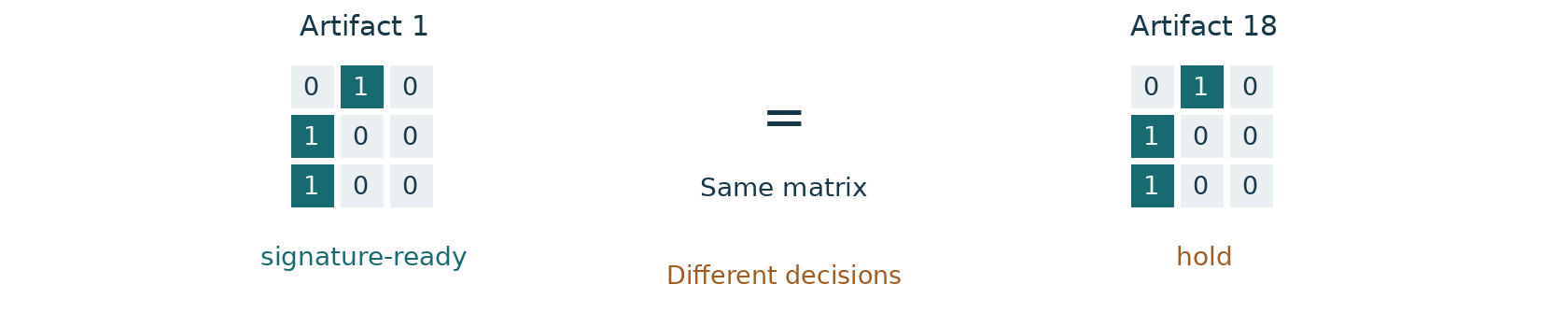
The mathematical condition can be stated without formulas. If two records become one code, any conclusion recoverable from that code alone must be the same for both. Different decisions paired with identical matrices give an exact counterexample to recovering the decision from the matrix alone. This applies the classical factorisation criterion to KASVD material; it does not introduce the criterion itself.
The practical outcome is a requirement to keep the full passport and a verifiable reference alongside the numerical projection. The package implements passport_ref resolution and refusal when the namespace or snapshot does not match. Preserving a record of evidence does not establish that the evidence is sufficient.
The number 153 is not a software error rate or a measure of forecast quality. It describes decision conflicts within the audited register and explains why a spectrum alone must not replace the evidential history.
Analyzer supports teachers
Imagine checking an assignment whose solution resembles the model answer, but gives x = 3 for x + 3 = 5. In a synthetic test of this kind, an incorrect submission received 98.3% structural similarity and an index of 75.5 out of 100. Its evidential status remained ABSTAIN, meaning that there was insufficient basis for an affirmative conclusion. [2–3]
The expanded check on 19 October covered 11 cases. A correct control and variants with a wrong digit or sign could receive the same 100% similarity and the same 75.5 index. This result helped define the educational mode more precisely: organise the review and recording of comments while leaving subject correctness to the teacher.
| Displayed result | How to interpret it |
|---|---|
| Structural similarity | Resemblance of the representation to a reference |
| Subject correctness | Not automatically checked |
| Final decision | Entered by the teacher |
Six questions for a systematic review
The checklist asks about alignment with the assignment; concepts and terminology; grounds for claims; the link between reasoning and conclusion; sources and quotations; and the conditions and limits of the conclusion. Comments can be tied to a passage and supplemented by the teacher. All manual decisions initially read Not checked. [2]
In Sites v60, the automatic school grade out of five was removed from the educational display. The six decisions and final result are not filled from the structural index. A manual offline HTML form supports saving and transferring the teacher's notes; it does not calculate similarity or check correctness. It is a separate tool and should not be confused with the offline analyzer.
The intended benefit for teachers is a consistent review process and more traceable comments. For students, it is a clearer indication of what needs revision. Time savings, classroom usability and pedagogical accuracy have not yet been independently measured. Publishing the educational mode enables those studies; it does not substitute for them.
New software packages and access to materials
Seven Android and Windows candidates were prepared on 19 October. They develop the online and offline Analyzer branches, including educational warnings and a manual teacher decision. Branch numbering differs for historical reasons; these are not seven independent mathematical engines. [4]
| Platform and mode | Prepared candidates |
|---|---|
| Android offline | 1.05.7 EDU RC2 |
| Android online | 0.10 EDU RC1 |
| Windows offline | 1.05.07 EDU RC2: Modern x64, Update, Compatibility x64 and x86 |
| Windows online | 0.10 EDU RC1 x64 |
The Android packages are signed with the original keys for their respective branches. The Windows packages have no Authenticode signature. The build report lists 124 emulated educational and data preservation checks, 7 activation tests and 13 checks of the Windows online wrapper. These separate test groups cannot be added into a measure of scientific validity.
On 22 October, all seven binary packages were retrieved through connected Drive and matched by size and SHA-256. Both software catalogues were checked in a live desktop browser. Descriptions and checksums are public; candidate downloads are restricted to the owner. Their status remains NOT_ACCEPTED, and native Android and Windows acceptance is NOT_RUN. [5]
Online wrappers open the current website and require a connection. Offline builds use their own code and data; numerical equivalence between web and offline algorithms is not claimed. Installation, updates to existing profiles, export, restoration and safe rollback still need testing on real devices. Full logical restoration under KLT-M4-LOGICAL-BACKUP-1 remains NOT_IMPLEMENTED. [4–5]
Two successive website updates on 23 October
Book of Changes research first appeared in Analyzer v62, KLT-MATDES v33 and the Sites exhibition v11. Publication of monograph v0.4 then brought them to v63, v34 and v12 respectively; the Floot exhibition was also updated. These numbers identify website publications, not new APK versions. Earlier materials were retained. [6, 8]
The Book of Changes as a precise research model
The six lines of a hexagram form a small but conceptually rich object. Position matters, the configuration can change, and one sign can be interpreted differently in different contexts. Research on the Book of Changes therefore makes it possible to compare mathematical structure with Chinese philosophical questions about situations, change and the grounds for action. [7]
In the model, each line is written as zero or one, with positions read from bottom to top. This gives 64 states. A six-bit mask specifies which lines change; XOR switches the selected positions. The full formal set contains 4096 state-and-mask pairs, including no change. This counts model possibilities, not observations or validated predictions.
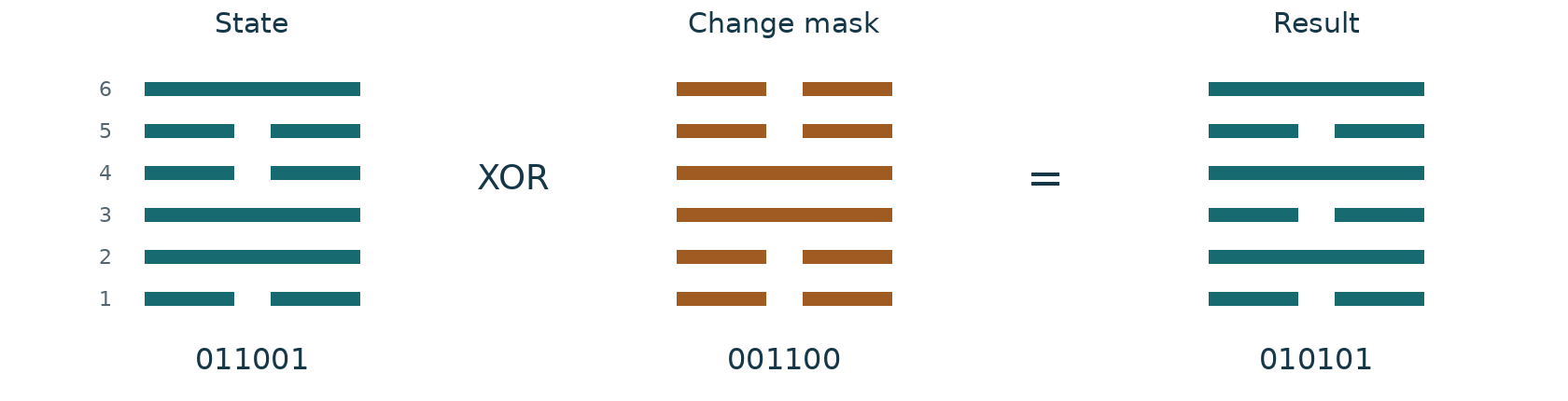
A geometric representation supports the study of retained distinctions and harmonic relations. Typed dynamics separately defines operations, their admissible inputs and a return to a new action. Geometry itself does not select the transition mask: prediction needs a justified selection law and a separate evaluation of its outcome.
Monograph v0.4, assembled on 23 October, retains 22 chapters, examples, an atlas and 11 figure placements. The PDF has 67 pages. Mathematical refinements, attribution to predecessors and limits on authorship claims are brought into agreement. The ARBD-HEX research package contains domain code, data and a forecast journal. Publishing that code does not establish server integration into Analyzer or MATDES. [6–8]
Its philosophical value lies in making interpretations explicitly comparable: which distinctions each retains, what context a conclusion needs, and where formalisation ceases to carry meaning. Modern operators are not attributed to ancient authors. H15, the assignment of philosophical roles to channels, remains an interpretive hypothesis; textual and independent substantive validation continue.
The research programme and the next testable step
The distinctive elements of Kurpishev's programme are best described through its concrete organisation of inquiry. This work documents a reper based problem formulation with explicit evidence and domain; coordination of events and states with a projective-harmonic representation; typed operator composition; checks that data reduction preserves the meaning needed for a chosen question; and links from results to passports and review journals. [1, 7]
Authorship of this implementation does not mean that every mathematical component is new. Version 0.4 explicitly acknowledges Andreas Schöter's 1999 precedence for the three-bit correspondence profile and the partition of 64 states into eight classes of eight. Binary encoding, XOR and classical projective constructions are likewise not claimed as discoveries of the project. After an invertible recoding, the P20 point set is the standard affine sign cube. [7, ch. 3–6, 16]
Properties of the chosen representation and operators are proved within the model. For example, D3's seven-coordinate statement applies to an explicitly restricted class of representations; P22's auxiliary harmonic points lie outside the original 64 states. These precise boundaries support a substantive discussion of the contribution. Global priority for the integrated programme has not been established.
| Level | Established result or open question |
|---|---|
| Mathematics and data | Counterexamples to information preservation; proofs within the declared model |
| Software | Builds, file checks and specified software scenarios |
| External validation | Predictive effectiveness and pedagogical validation not established |
The next steps have clear criteria: test candidates on real Android and Windows devices while preserving user databases; study teachers using the workflow; obtain independent Chinese annotation; preregister a forecasting task and a matched control, then evaluate the result on data not previously used.
SCIENCE=ABSTAIN, EXT_RUN=NOT_RUN and truth_layer_promotion=0 remain in force. For Book of Changes research, external_validation=NOT_RUN, H15=OPEN and global_priority=NOT_ESTABLISHED. For chemistry, DHC_chem=OPEN-NOT-CONFIRMED. These labels help readers distinguish completed work from the next scientific question.
The project invites focused discussion: a mathematician can inspect proof assumptions, a teacher can examine the checklist's clarity, and a specialist in Chinese thought can assess interpretive precision. Reproducible criticism and testing give the author's method a concrete path for development.
Issue materials and sources
This issue covers 10–23 October 2026 and was prepared on 24 October, Europe/Kaliningrad. Facts come from the Google Drive reports read for this issue and monograph v0.4. Test outcomes are reported from those documents; the original software tests were not rerun while preparing the digest.
- KASVD Information Preservation Audit v1.0 · 14.10.2026
- EDU ACCEPT 02 · 17.10.2026
- EDU BOUNDARY 03 · 19.10.2026
- EDU REBUILD 05 · 19.10.2026
- EDU CATALOG AUDIT 07 · 22.10.2026
- Yijing Publication Report · 23.10.2026
- Книга Перемен и метод KLT ARBD v0.4 · 23.10.2026
- Publication Receipt v0.4 · 23.10.2026
- LK2 Digest 2–9 October v1.1 · 12.10.2026
Links point to the source documents; Drive access follows their existing permissions. Public research pages and the new digest files are available on the project's websites. The full v0.4 monograph is in Russian; RU/EN/ZH web pages do not by themselves imply three complete translations of the monograph.
Issue v1.1 for 2–9 October [9] remains archived. The new package continues the series under separate filenames. The Russian, English and Chinese versions of this issue share the same structure, figures, sources and scientific limits.